What Is a Living World?
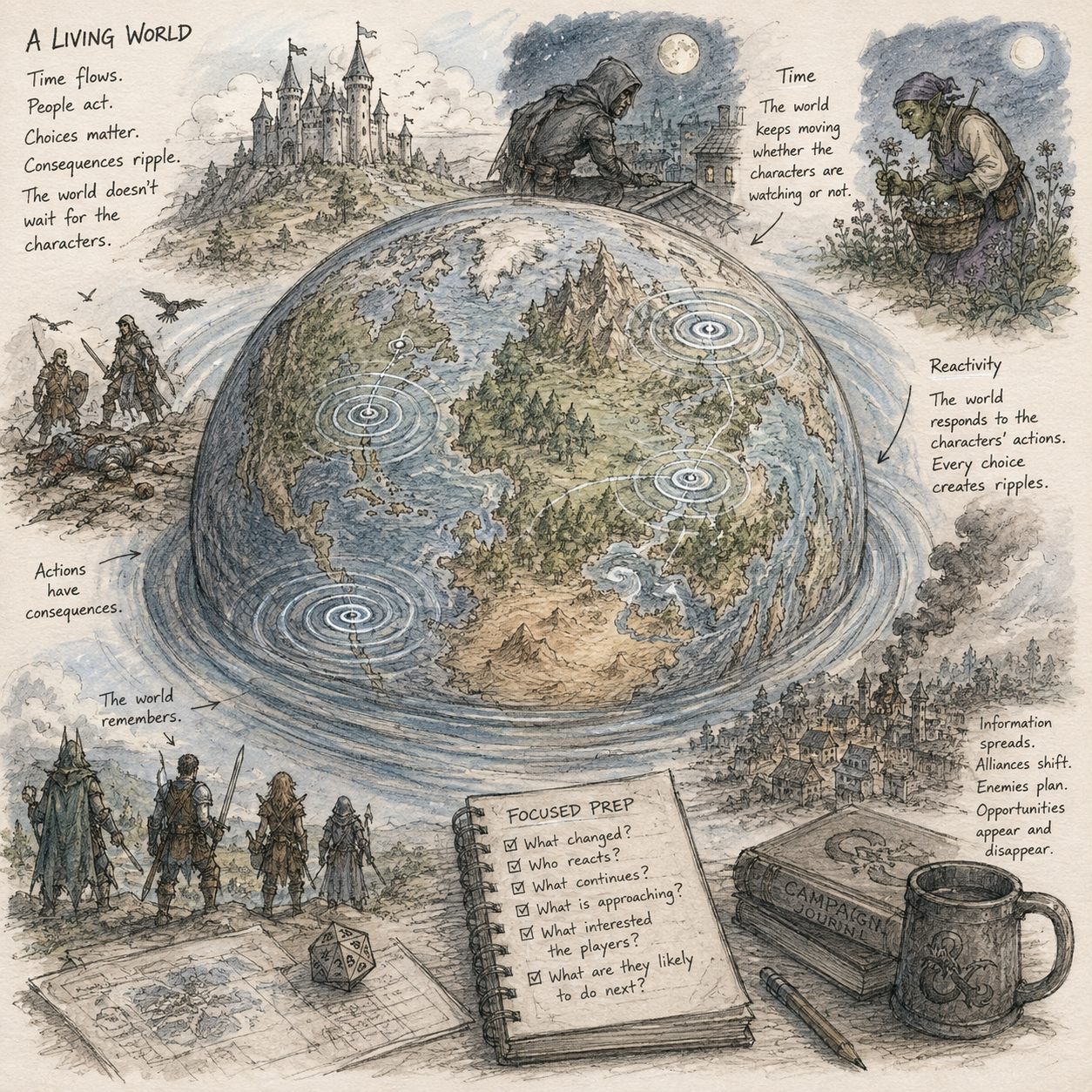
When GMs and players picture a living world, it is often romanticized: a large, continuous, reactive world where characters come across events already in progress. Rather than the world waiting in a paused state for the characters to arrive, it ebbs and flows like ocean waves.
Any GM who has attempted this can tell you that it can feel like juggling an endless collection of Grandma’s china plates. If one plate falls, you’re out of the will for good.
Trying to keep every NPC, faction, location, threat, event, and consequence moving at the same time quickly becomes impossible.
But you don’t need to.
A living world doesn’t require the GM to simulate an entire fantasy world. It requires the GM to create the experience of a world that continues beyond the player characters.
The secret is focused preparation: identifying what is reasonably likely to matter, predicting what the players are reasonably likely to do, and allowing the consequences of their actions to continue moving through the world.
When it works, the world feels organic and responsive. Player choices—and their decisions to ignore particular threats—have tangible, sometimes compounding consequences.
The world doesn’t wait for the characters.
And it doesn’t forget them.
Why Create a Living World?
Many GMs and players grew up reading fantasy novels, watching movies, writing stories, and immersing themselves in fictional worlds.
Those worlds have continuity.
Characters they met earlier return. Decisions have consequences. Places change. Enemies remember. Relationships develop. Events happen while the protagonists are somewhere else.
Players often want that same depth from their TTRPG campaigns.
They want their actions to have consequences because, without consequences, the world can begin to feel flat. They want to be remembered, whether their deeds were heroic, villainous, or somewhere in between. They want to feel as though they are inhabiting a fantasy world rather than moving between isolated encounters.
A living world also creates immediacy.
Problems don’t necessarily wait until the characters are ready to deal with them. Opportunities can disappear. Enemies can prepare. People can move. Situations can deteriorate—or occasionally resolve themselves—without the characters’ involvement.
Choosing to do nothing is still a choice.
The world keeps moving.
What Makes a World Feel Alive?
There are two fundamental concepts that make a TTRPG world feel alive:
Time and reactivity.
Time
By time, I don’t mean that every second of a session needs to be tracked.
I mean that time has a continuous flow.
NPCs, locations, creatures, factions, and other inhabitants of the world don’t simply stand still because the player characters aren’t interacting with them.
When the characters are asleep, the thieves’ guild may be active in the streets.
When the party leaves a dungeon, the monsters’ allies may reclaim that space.
The merchant they met three towns ago continues travelling.
The wounded bandit who escaped them has time to reach his leader.
And when the characters stand in a dungeon hallway arguing about who should open the secret door, whether they should open it, and exactly how they should open it, the goblin apothecary on the other side of that door still has to go out and pick flowers under the moonlight.
So he opens the door.
The world doesn’t pause while the players deliberate.
Time creates movement, and movement creates situations the players couldn’t have encountered if everything had remained frozen until they arrived.
Reactivity
Reactivity means the world responds to the characters’ choices and actions.
Every encounter, event, or scene is like a pebble dropped into water, creating ripples that can extend beyond the original event.
If a character steals from an NPC, that NPC is going to be upset.
If the characters leave a trail of bodies behind them, eventually someone is going to notice.
A family member may swear revenge. A guard may start looking for the murderer. A frightened witness may spread the story. An enemy may become more cautious after hearing what happened to the last group that confronted the characters.
Not every action needs to create a campaign-changing consequence.
The world simply needs to respond when a response is reasonable.
Sometimes the ripple is tiny.
Sometimes it disappears almost immediately.
Sometimes one pebble eventually creates a wave.
The Problem with Living Worlds
The biggest mistake GMs make when trying to create a living world is attempting to prepare for everything.
You can’t.
Players can attempt virtually anything, and a fantasy world can contain thousands of people, locations, factions, creatures, conflicts, and events.
Trying to simulate all of it isn’t worldbuilding.
It’s madness.
Fortunately, players aren’t going to interact with all of it.
A GM only needs enough information to understand what is happening around the characters, what may reasonably intersect with them, and how the world is likely to respond to what they do.
This is where focused preparation becomes essential.
Prepare What Is Reasonable
Reasonable preparation starts with the characters’ immediate circumstances.
Where are they?
Who’s nearby?
What’s happening around them?
What are they currently trying to accomplish?
What unresolved situations are already in motion?
What are the players likely to investigate, confront, avoid, steal, negotiate with, attack, or completely misunderstand?
GMs are predictors—the seers of the TTRPG world.
You know your players. You know their characters. You know what has caught their attention. You usually have a reasonable idea of the things they’re considering doing next.
Use that information.
This is not about deciding what the players will do.
It’s about identifying possible player actions and preparing for the most reasonable ones.
If the party has spent twenty minutes discussing whether to break into the local lord’s manor, preparing something for that possibility is probably worthwhile.
If nobody has shown the slightest interest in the abandoned lighthouse seventy miles away, you probably don’t need to design its underground catacombs tonight.
Players will still surprise you.
They should.
Focused preparation simply means that when they do something predictable, you’re ready—and when they do something completely unpredictable, you haven’t wasted hours preparing twenty other possibilities they didn’t choose either.
Predict the World Too
Prediction works in both directions.
Don’t only ask:
What are the players likely to do?
Also ask:
What is the world likely to do?
Suppose the characters walk into a heavily guarded castle.
Could they realistically wander through it without a single guard stopping or questioning them until they happen to encounter the one guard who knows about the secret door they’ve been searching for?
Probably not.
The inhabitants of the world have motivations, responsibilities, knowledge, relationships, and goals of their own.
A guard guards.
A merchant wants to sell things.
A frightened witness may hide.
A thief doesn’t necessarily wait in the alley indefinitely until the characters trigger the encounter.
Thinking about what NPCs reasonably want and what they are likely to do creates much of the appearance of an independent world without requiring enormous amounts of preparation.
Follow the Ripples
After the characters act, consider what their actions changed.
You don’t need to map every possible consequence immediately.
Start with the obvious ones.
What changed?
Did someone die? Was something stolen? Was a secret revealed? Did the characters save someone? Did they make an enemy? Did they leave something unfinished?
Who knows?
Consequences require information. The king can’t react to something he doesn’t know happened. Consider who witnessed the event, who might discover it afterward, and how information could reasonably travel.
Who cares?
Not everyone who learns something will act on it. Identify the people or groups with a reason to respond.
What might they do?
Consider the most reasonable reactions based on their motivations and resources.
Could that reaction intersect with the characters?
If so, you’ve found something worth preparing.
A group of bandits attacks the characters and one escapes.
You don’t need to immediately write a six-session revenge arc.
The survivor might return to the bandit leader.
The leader now knows something about the party.
What happens next depends on circumstances.
If the characters leave the region, perhaps nothing comes of it.
If they remain nearby, the bandits may begin watching them.
If the characters start hunting the bandits first, the situation changes again.
The consequence isn’t a predetermined encounter.
It is a change in the state of the world.
Let the Players Tell You What Matters
Players are remarkably good at identifying the parts of your world they want more of.
Unfortunately, they rarely do it by politely saying:
“GM, I would like this NPC to become a recurring character.”
Instead, they’ll spend forty minutes talking to the bartender you invented twelve seconds ago.
They’ll become fascinated by an object you intended as scenery.
They’ll return to a merchant you thought they’d never see again.
They’ll develop a theory about an insignificant clue.
They’ll hate an NPC you expected them to love.
They’ll adopt someone who didn’t even have a name until they asked.
Pay attention.
Player attention is information.
You don’t need to turn every fixation into a hidden conspiracy or reveal that every meaningless trinket was secretly an ancient artifact.
But when players repeatedly return to something, they’ve told you that it matters to them.
That makes it an excellent candidate for future preparation.
Let important things grow into importance.
Prepare Between Sessions
One of the easiest times to maintain a living world is immediately after a session, while you still know what happened and what caught the players’ attention.
Before preparing the next adventure, ask:
What changed?
Record the meaningful changes caused by the session.
Who reacts?
Identify NPCs, creatures, or factions reasonably affected by those changes.
What continues?
Advance situations that weren’t resolved simply because the session ended.
What is approaching?
Consider consequences, threats, opportunities, or events that may reasonably intersect with the characters.
What interested the players?
Notice NPCs, locations, clues, objects, mysteries, and ideas that received unexpected attention.
What are the players likely to do next?
Identify their most reasonable options and prepare for those possibilities.
Then prepare the points where those things are most likely to intersect.
You aren’t writing the next chapter of a novel.
You are preparing a world for the players to enter again.
Focused Prep Makes Continuity Possible
A living world does not require encyclopedic worldbuilding.
The GM doesn’t need to know four generations of their newest noble’s family history unless those generations actually matter.
But the GM probably does need to know that the bandit leader is following the party.
That’s the difference between information about the world and information that makes the world move.
Focus on movement.
Focus on consequences.
Focus on the people and places the characters are approaching, and the people and places their actions have left behind.
Predict what your players are reasonably likely to do, while leaving them completely free to prove you wrong.
Allow time to pass.
Let NPCs act.
Follow the ripples of player choices.
Remember what the players care about.
You don’t need to keep every plate in the world spinning.
Just keep the ones that matter in motion.
That’s enough to make the world feel alive.
Leave a Reply